
Why Stocks Are Rising While Bonds Are Falling: Mana’s Q3 2026 Market Review
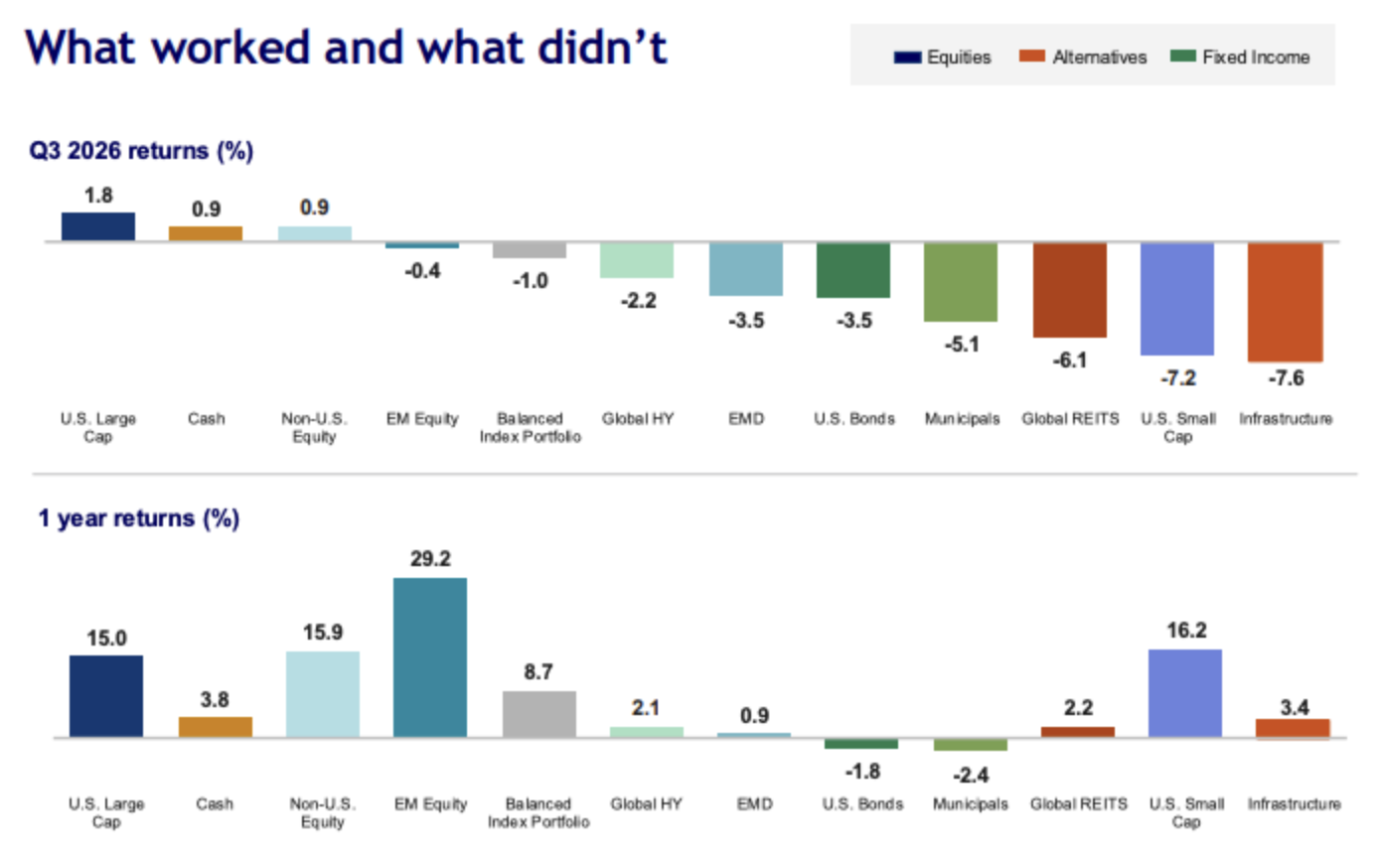
Source: Russell Investments Q3 2026 Economic & Market Review.
The stock market is approaching record highs. The bond market just experienced one of its worst quarters in decades. And depending on who you ask, the American economy is either doing remarkably well or feeling increasingly difficult to navigate.
How can all three things be true?
Welcome to the great disconnect of 2026.
The third quarter offered a striking illustration of how differently markets and households can experience the same economic environment. Strong corporate earnings continued to support stock prices, while rising interest rates drove bond prices lower. Meanwhile, the benefits of economic growth remained unevenly distributed across American households.
Understanding why these things are happening simultaneously can help investors make sense of an otherwise confusing market.
Q3 2026 Market Performance: A Tale of Two Asset Classes
U.S. equities continued their advance in the third quarter, with the S&P 500 closing less than 1% below its all-time high. International equities also contributed positively, with emerging markets gaining roughly 25% year-to-date through early October.
Fixed income told a dramatically different story. The Bloomberg Municipal Bond Index declined 4.36% in September alone and 6.35% for the full quarter, marking its worst quarterly performance since 1981. Even gold, traditionally viewed as a diversifier during uncertain periods, struggled, declining approximately 4% year-to-date as rising real interest rates reduced its near-term appeal.
For investors accustomed to thinking of bonds as the stable portion of their portfolios, these results were particularly uncomfortable.
But the divergence between stocks and bonds wasn't random. It reflected two powerful forces working simultaneously: an economy that remained stronger than many anticipated and a Federal Reserve responding to that strength with higher interest rates.
A Two-Speed Economy: Why Strong Markets Don't Tell the Whole Story
The American economy is growing, but the benefits of that growth aren't being shared equally.
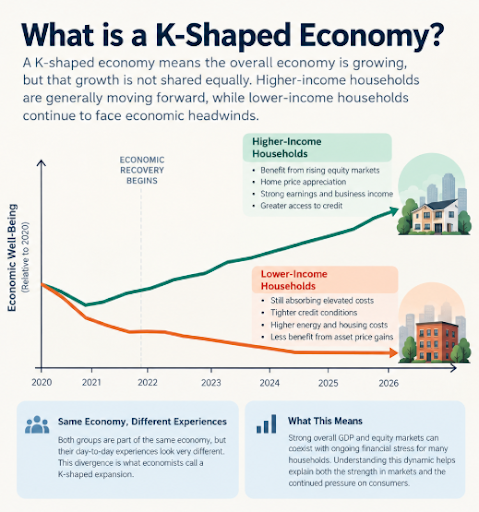
Wealthier households have continued to benefit from rising stock markets, home price appreciation, and strong corporate earnings. Lower-income households, meanwhile, are still absorbing years of elevated living costs, tighter access to credit, and more recently, higher energy prices.
In September 2026, research from PIMCO described this dynamic as a K-shaped expansion, where different segments of the economy move in fundamentally different directions.
This helps explain something that can otherwise feel contradictory: economic headlines celebrating strong growth while many households report feeling financially stretched. It also illustrates an important distinction between the stock market and the broader economy. The stock market reflects investors' expectations about the future earnings of publicly traded companies. It isn't a comprehensive measure of household financial well-being. Large companies can deliver record profits even when significant portions of the population are struggling to keep up with everyday expenses.
Both realities can exist at the same time.
For those who have benefited from several years of market gains, this disconnect may also prompt a different kind of financial question: What do we want to do with the wealth we've accumulated? We've increasingly heard investors express interest in using their financial resources to support the people and causes they care about. For those considering charitable giving, strategies involving appreciated investments or donor-advised funds may be worth exploring, depending on individual circumstances and applicable tax rules.
The broader point is that financial success creates choices, and those choices can extend well beyond investment returns.
The strength of the overall economy also helps explain why the Federal Reserve took action this quarter, and why that action was particularly painful for bond investors.
Why Did Bond Prices Fall So Sharply in Q3 2026?
In September, the Federal Reserve unanimously voted to raise the federal funds rate to a range of 3.75% to 4.00%, following a unanimous decision to hold rates steady in June. The economic data between those meetings told a compelling story.
The Atlanta Fed's GDPNow model estimated third-quarter economic growth near 5%. The labor market remained at full employment, and inflation continued running above the Federal Reserve's 2% target for the fifth consecutive year.
With the economy showing considerable resilience and inflation remaining stubborn, the Fed had reason to maintain a restrictive monetary policy. Yardeni Research, one of the macroeconomic research sources we follow closely, projected another one or two rate increases before year-end.
Bond markets reacted aggressively.
The yield on the 10-year U.S. Treasury reached an intraday high of 5.22% in late September. Real yields, which account for inflation, climbed to their highest levels since 2008.
Why do rising interest rates hurt existing bonds?
When interest rates rise, newly issued bonds generally offer higher yields. That makes older bonds paying lower interest rates less attractive, so their market prices fall. The longer a bond's duration, a measure of its sensitivity to interest rates, the more dramatically its price will generally react to changes in yields.
This is one reason investors can experience meaningful declines in their bond holdings even when the underlying borrowers remain financially healthy.
A bond's market price and its ability to repay principal are related, but they are not the same thing.
Why were municipal bonds hit especially hard?
Municipal bonds faced additional pressure beyond the general increase in interest rates.
According to Asset Preservation Advisors, more than $50 billion in new municipal bonds came to market in September alone. On September 23, secondary-market selling volume reached approximately $7.3 billion, the highest single-day total on record.
This combination of record supply and heavy selling created substantial downward pressure on prices.
Importantly, the selloff was not primarily a story about deteriorating credit quality.
State and local governments remained in relatively strong fiscal condition, with state and local tax revenue increasing 5.75% during the first half of 2026. Defaults among investment-grade municipal issuers have historically been exceptionally rare.
Investors holding individual investment-grade municipal bonds could therefore see substantial declines in their quoted market values without a corresponding deterioration in the issuer's financial health.
For investors holding an individual bond to maturity, interim price fluctuations may have little effect on the amount of principal ultimately repaid, assuming the issuer meets its obligations. Investors who sell before maturity, however, may realize losses, and even bonds held to maturity remain subject to credit, inflation, and other risks.
These distinctions matter, particularly for retirees and investors who depend on their portfolios for ongoing income.
The Silver Lining: Higher Bond Yields Can Improve Future Returns
There's a counterintuitive benefit to rising interest rates that often gets lost amid headlines about falling bond prices.
Higher yields today can create better income opportunities for investors tomorrow.
While rising rates reduce the market value of existing fixed-rate bonds, they also allow investors purchasing new bonds to lock in higher levels of income. During the third-quarter municipal bond selloff, yields on high-quality municipal bonds became especially compelling for investors in higher tax brackets.
For taxpayers in the highest federal bracket, certain high-quality municipal bond yields crossed the equivalent of 8% on a taxable-equivalent basis. According to institutional asset manager Nuveen, these higher yields made municipal bonds increasingly competitive with investment-grade taxable credit on an after-tax basis.
Taxable-equivalent yield is a way to compare the income from a tax-exempt bond with the yield an investor would need from a taxable bond to produce the same after-tax income. The result varies depending on the investor's tax bracket and the specific bond.
For investors seeking dependable cash flow, particularly those approaching or already in retirement, this shift can be meaningful.
Of course, attractive yields don't eliminate risk. Interest rates could continue rising, bond prices could fall further, and credit quality still matters.
But there's an important distinction between an asset becoming less valuable because its underlying fundamentals have deteriorated and an asset declining in market price because newly available investments offer more competitive yields.
For long-term investors, understanding that difference can make periods of bond market volatility considerably easier to navigate.
Why Did Stocks Keep Rising Despite Higher Interest Rates?
If rising interest rates were so difficult for bonds, why didn't they derail the stock market?
The short answer: Corporate earnings remained strong enough to offset the pressure from higher rates.
According to Yardeni Research, forward earnings per share for the S&P 500 increased approximately 28% year-to-date through the third quarter. That earnings growth outpaced the increase in stock prices, which meant the market's valuation multiple actually compressed during 2026.
Put simply, even though the S&P 500 was approaching record highs, investors were paying less for each dollar of expected corporate earnings than they had been at the beginning of the year.
This is an important distinction.
Stock prices can rise because investors are willing to pay increasingly expensive valuations, or because the underlying companies are generating more earnings. Those two environments can look similar on a market chart but represent different fundamental conditions.
In 2022, rising interest rates and weakening corporate earnings occurred simultaneously, creating significant pressure on stock prices.
In 2026, earnings growth provided a meaningful offset to the effects of higher rates.
That doesn't mean stocks are immune to future volatility. High earnings expectations can be difficult to sustain, and market valuations remain sensitive to changes in growth, inflation, and interest rates. But it does help explain why stocks and bonds responded so differently to the same economic environment.
What This Quarter Teaches Us About Diversification
Periods like Q3 2026 can challenge some of the most common assumptions about diversified investing. Investors often think of stocks as the growth engine of a portfolio and bonds as the stabilizer. Historically, that framework has served investors well over long periods, but it doesn't guarantee that bonds will rise whenever stocks experience volatility, or that traditionally defensive assets will always deliver positive returns.
When inflation and interest rates become dominant market forces, different asset classes can respond in unexpected ways.
Gold provides another example: Despite its reputation as a potential hedge against uncertainty, gold declined approximately 4% year-to-date through early October. Rising real yields made interest-bearing investments relatively more attractive than gold, which produces no income. At the same time, central bank demand for gold remained well above pre-2022 levels, according to WisdomTree's fourth-quarter 2026 research.
These competing forces illustrate why an asset's short-term performance and its potential long-term role in a portfolio aren't necessarily the same thing.
Diversification isn't about ensuring that every investment performs well simultaneously. It's about combining assets with different economic sensitivities so that a portfolio isn't entirely dependent on one market outcome.
That also means evaluating investments according to the job they're intended to perform. An investment held primarily for income shouldn't necessarily be judged by the same standards as one intended to generate long-term capital appreciation. Similarly, a diversifying asset may disappoint during certain market conditions while still serving a useful role over a full investment cycle.
The more important question isn't whether every investment is performing well this quarter. It's whether the portfolio, taken as a whole, continues to support the investor's long-term objectives.
What Do the 2026 Midterm Elections Mean for Investors?
With the midterm elections approaching on November 3rd, another question is understandably on investors' minds: What happens to markets after Election Day?
Historical market data offers some perspective. According to YCharts, since the S&P 500 was established in the 1950s, the index has not recorded a negative return over the 12 months following a midterm election. The average total return over those periods has been approximately 16.9%. Those figures are striking, although historical patterns are never guarantees of future performance.
The market has also entered this election season from an unusually strong position. Equities were already up roughly 13% heading toward Election Day, compared with a historical midterm-year average of approximately 2.8% at that point in the cycle.
The most comparable historical example was 1998, when stocks entered the midterm election period with similarly strong gains and subsequently advanced another 23.6% over the following 12 months.
It's tempting to interpret those statistics as a forecast, but that would miss the more durable investment lesson.
Should investors change their portfolios based on election outcomes?
History generally argues against making investment decisions based primarily on political preferences or expectations about which party will hold power.
YCharts examined the hypothetical returns of investors who remained invested only during administrations led by one political party, compared with investors who stayed invested throughout.
Since 2012, the annualized returns in that analysis were approximately:
Republican administrations only: 5.5%
Democratic administrations only: 7.2%
Continuously invested: 13.1%
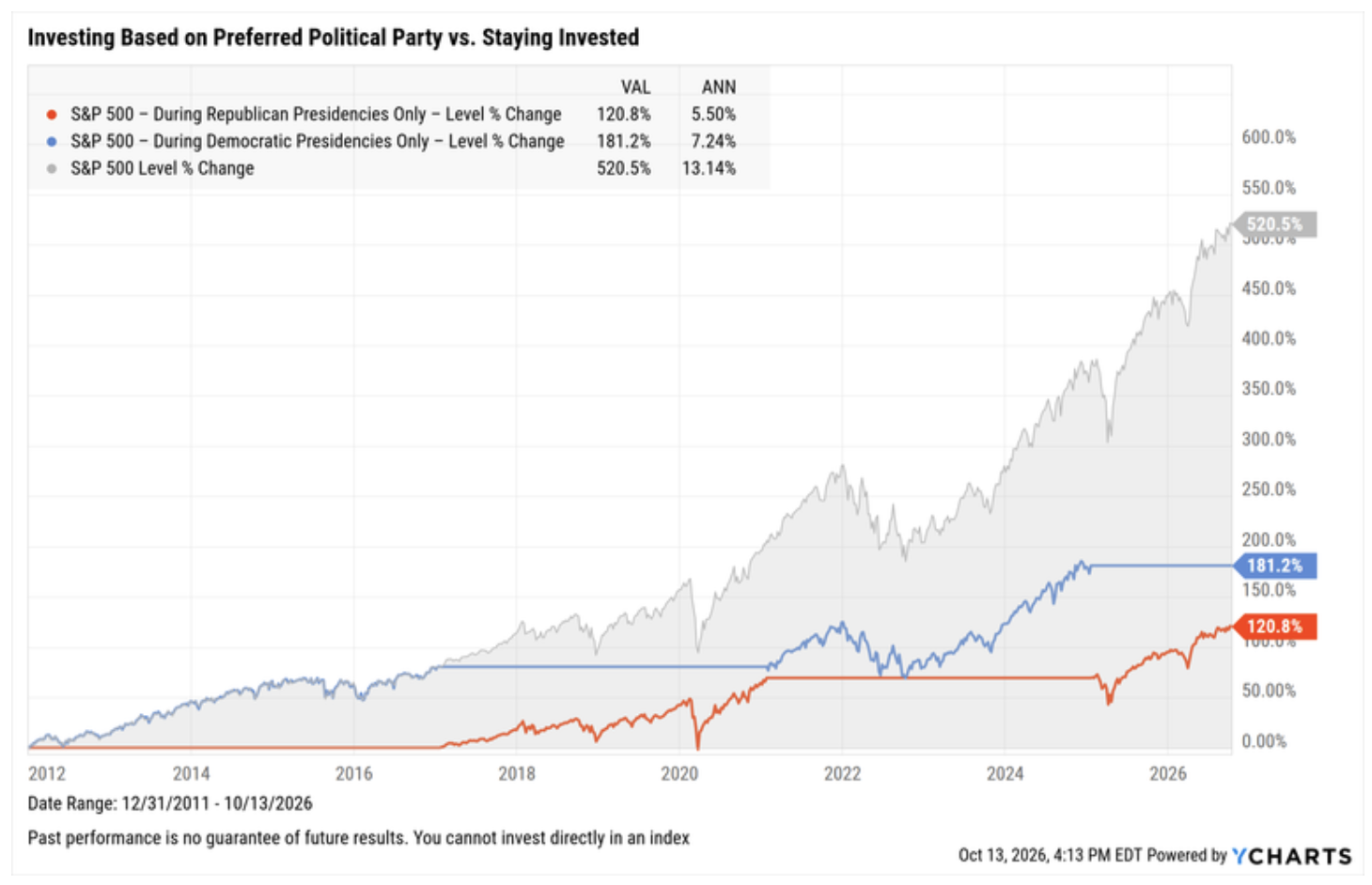
These comparisons illustrate the potential cost of repeatedly moving money in and out of the market based on election outcomes. Government policy certainly matters. Tax legislation, fiscal spending, trade decisions, and regulatory changes can all influence industries, companies, and the economy. But predicting how those policies will translate into future market returns, and accurately timing investments around them, is extraordinarily difficult. Markets respond not just to political outcomes, but to expectations, valuations, corporate profitability, monetary policy, and countless other factors.
Long-term investors are generally better served by building portfolios that can withstand different political and economic environments rather than attempting to predict which party will produce the best market returns.
What Does All of This Mean for Long-Term Investors?
The market has given investors plenty to think about this quarter…
Stocks have continued climbing. Bonds have experienced an unusually painful stretch. And the broader economy remains a study in contrasts, with strong aggregate growth obscuring very different financial realities for American households.
For us at Mana, the most important takeaway is that investors today should ensure the investments they own still serve the life they're trying to build.
After several years of strong equity returns, some investors may find they're closer to their long-term financial goals than they realize. That can create an opportunity to reassess how much risk they actually need to take.
Others may be in a season of life where staying invested and giving their portfolio time to grow matters most. Investors relying on portfolio income may want to pay particular attention to how higher bond yields affect their future cash flow.
There isn't one correct response to this market environment because investors aren't all trying to accomplish the same thing. What matters is having an investment strategy grounded in your goals, time horizon, income needs, and willingness to take risk.
Sources and Disclosures
YCharts total return data as of October 5, 2026.
Nuveen, Muni Minute, Dan Close, October 5, 2026.
PIMCO, How a K-Shaped Economy Affects Opportunities in Asset Based Finance, September 2, 2026.
WisdomTree Model Portfolio Investment Committee, Q4 2026 Quarterly Strategic Outlook.
Asset Preservation Advisors, Muni Moment, September 29 and October 6, 2026.
Yardeni Research, QuickTakes, September 2026.
YCharts, 2026 Midterm Election: How Do Markets Historically Respond?, October 15, 2026.
This commentary is provided for educational and informational purposes only and should not be construed as personalized investment, tax, or legal advice. Market data and opinions reflect the information available as of the dates indicated and may change. Past performance is not indicative of future results. All investments involve risk, including the possible loss of principal. Diversification does not guarantee a profit or protect against losses. Municipal bond income may be subject to certain taxes, including state and local taxes and the federal alternative minimum tax, depending on the security and individual circumstances. Consult your financial and tax professionals before making decisions based on your individual circumstances.
Follow our Instagram for personal finance tips and inspiration.
Stephanie Bucko and Cristina Livadary are fee-only financial planners based in Los Angeles, California. Stephanie is the Chief Investment Officer and Cristina is the Chief Executive Officer at Mana Financial Life Design (FLD). Mana FLD provides comprehensive financial planning and investment management services to help clients grow and protect their wealth throughout life’s journey. Mana FLD specializes in advising ambitious professionals who seek financial knowledge and want to implement creative budgeting, savings, proactive planning and powerful investment strategies. As fee-only fiduciaries and independent financial advisors, Stephanie and Cristina never receive commission of any kind. Stephanie and Cristina are legally bound by their certifications to provide unbiased and trustworthy financial advice.