
Mana’s Q2 2026 Market Review and Outlook
Asset Class Performance
Market performance in Q2 2026 was broad-based and strongly positive across nearly every asset class, a sharp reversal from Q1's dispersion and drawdowns. Emerging market equity led all categories, gaining 24.1% in the quarter and 43.5% over the trailing year. U.S. small cap followed at 21.5% for the quarter and 40.8% over one year. U.S. large cap returned 15.1% in Q2, recovering most of what the first quarter had taken, while non-U.S. equity added 10.2%. A balanced index portfolio gained 9.0%. Infrastructure, which had been a standout in Q1 at +8.1%, lagged in Q2 at 1.3%, though its one-year return remains strong at 15.8%. Fixed income was broadly positive but modest: U.S. bonds returned 0.7% for the quarter and 3.8% over the trailing year, and municipals added 1.7% in Q2. The chart below summarizes returns across major asset classes for both Q2 2026 and the trailing one year.
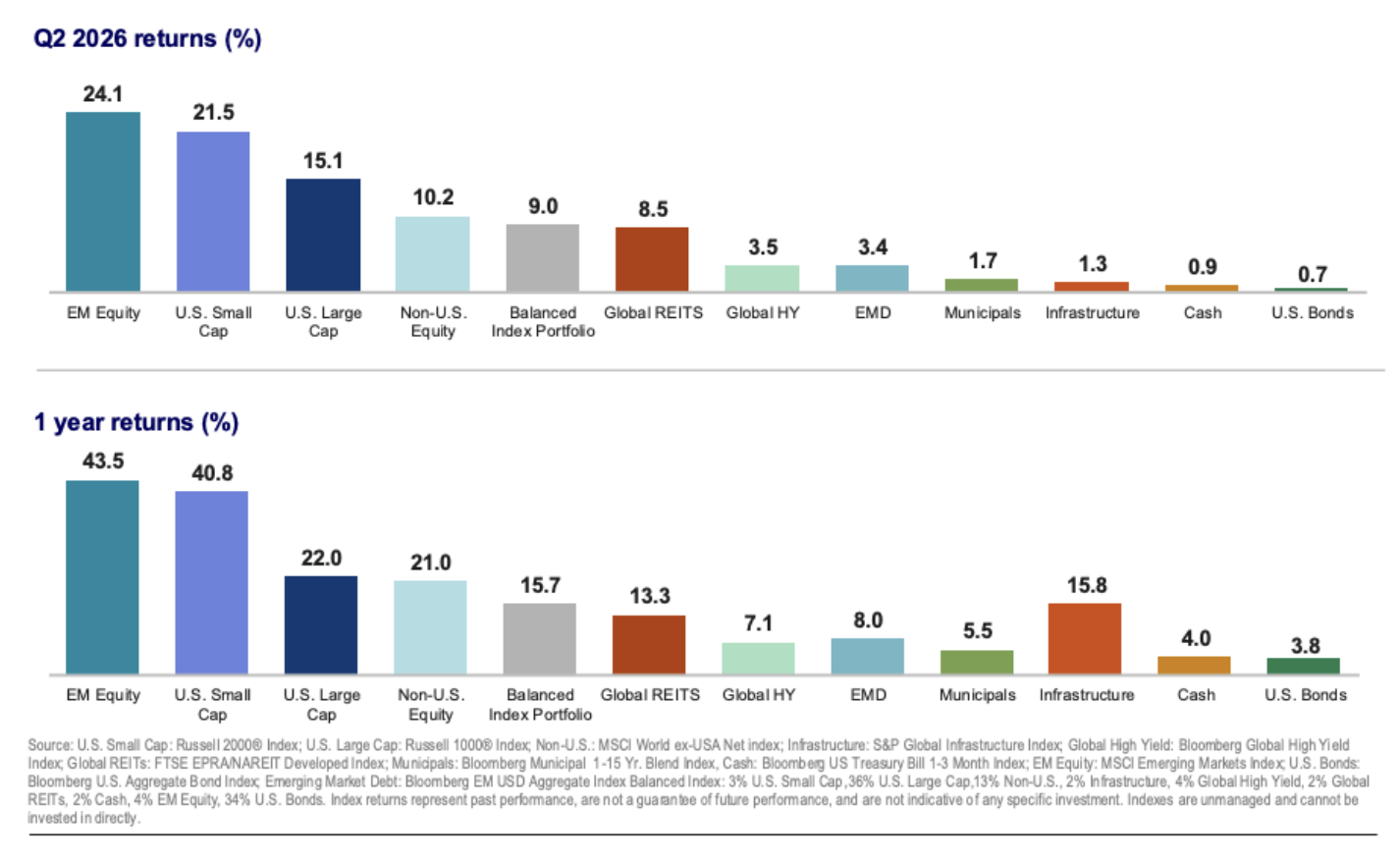
Source: Russell Investments Q2 2026 Economic & Market Review.
Investment Commentary & Outlook
Q2 was a strong quarter. The S&P 500 gained over 15%, recovering beyond what the tariff shock and the Iran conflict had taken in the first quarter. For portfolios built across geographies, sectors, and asset classes, the quarter highlighted why diversification works.
The more interesting story is where the returns came from: not the sectors generating the most attention heading into the year. The Magnificent Seven, the companies most frequently cited as must-own names in AI, tech, and innovation, are up just 2.6% year-to-date through mid-July, while the rest of the S&P 500 is up 14.3%. SpaceX, which generated more client questions than any single investment in recent memory, is currently trading near its IPO price after briefly touching $225 in its first week of trading. Emerging markets led both the quarter and the year, up over 24%. The areas attracting the most enthusiasm were not the ones delivering the returns. That is not unusual, it is how markets tend to work.
A New Chapter at the Fed
Jerome Powell's tenure as Federal Reserve Chair ended with something nearly everyone thought impossible when it began. When the Fed started raising rates in March 2022, the near-universal expectation was a hard landing: a recession, rising unemployment, and real economic damage. Instead, inflation came down, the economy kept growing, and unemployment stayed near historically low levels.
Kevin Warsh took over as Chair and ran his first Federal Open Market Committee meeting in June. The Fed held rates at 3.50–3.75%, which was broadly expected. What changed was the signal around the decision. The post-meeting statement was cut roughly in half. All language about future rate cuts was removed entirely. Nine of eighteen committee members now project at least one rate hike before year-end. The Fed's updated projections put core inflation at approximately 3.3% by December and the federal funds rate at 3.8% by year-end, up from the 3.4% projected in March. That is a meaningful shift in a short period of time.
The Federal Reserve's independence from political pressure is a cornerstone of its credibility. How Warsh navigates that, particularly with a vocal White House and midterm elections approaching, is something we are watching closely. For portfolios, the practical implication is clear: rate cuts are not coming to rescue duration risk.
SpaceX, Anthropic, and OpenAI
SpaceX began trading on June 12th under the ticker SPCX, pricing at $135 per share and opening at $150. The offering raised $86 billion, the largest IPO in U.S. history. In the first two days, shares surged above $225 and Elon Musk briefly became the world's first trillionaire. Since then, the stock has pulled back sharply. As of early July, shares are trading around $139, near and at times below the IPO price, as investors work through heavy capital expenditures, deep losses in the AI and launch divisions, and a $25 billion bond offering that came shortly after the listing.
IPO valuations tend to reflect maximum optimism, and the months that follow are often volatile as insiders become eligible to sell. SpaceX's employee lockup runs through December 2026, with tranches becoming eligible incrementally between now and then.
Many clients have asked how to participate in SpaceX and the broader wave of AI IPOs. On the IPO itself: shares at the offer price go to the large institutional clients of the underwriting banks. As an independent RIA, we do not broker primary allocations. The Nasdaq-100 adopted a fast-entry rule that can add a newly listed company approximately 15 trading days after it begins trading. SpaceX floated only about 4.3% of its total shares publicly, compared to 81% to 98% for the Magnificent Seven. When passive funds must buy into a very small float, a large volume of mandatory demand meets very limited supply.
Anthropic and OpenAI are both expected to go public, though timing on each may slip into 2027. Clients who want more concentrated exposure to AI or space, beyond what index inclusion provides, is a conversation we work through individually, sized to what makes sense within each person's broader financial plan.
On Elections and Markets
Midterm elections are four months away, and the political volume is already high. It is worth putting that noise in some context.
Since 1937, the S&P 500 has averaged 9.2% in midterm years versus 13.3% in other years, a gap that can sound alarming.5 The important context is what actually drove the underperformance in recent cycles. 2018 and 2022 were both midterm years, and both were negative. Both were driven by Federal Reserve rate hikes, not by the outcome of the election.5 According to J.P. Morgan Asset Management, in the 12 months following every midterm election since 1950, the S&P 500 has delivered a positive return every single time, regardless of which party won.
The other concern we hear from clients regularly is whether this market is an AI-driven bubble. It is worth taking seriously. Hundreds of billions of dollars are flowing into AI infrastructure, and investors are right to ask whether those investments will generate returns. Competition among AI providers is intensifying, including from Chinese companies advancing faster than many expected. These are real uncertainties, not noise to dismiss.
What the data does not support is a comparison to the late 1990s technology bubble. That rally was driven almost entirely by multiple expansion: the forward price-to-earnings ratio of the S&P 500 Information Technology sector reached 55 times earnings just before the crash in 2000. Today it sits at 22.2 times, not far above the broad S&P 500's 20.4 times. The 1990s were fueled by fear of missing out, with investors paying enormous premiums for companies with little to no earnings. The current environment is different. S&P 500 companies are expected to report 21.6% earnings growth in Q2 year-over-year, and expectations for Q3 and Q4 are equally strong.2 Forward profit margins just hit a record 16.1%, reflecting genuine cost discipline and pricing power across a broad range of industries.
The breadth of the market reinforces that picture. The equal-weighted S&P 500, which treats every company the same regardless of size, is outperforming the market-cap-weighted index. Small caps are at new highs. Financials, Healthcare, and Industrials are all breaking out. Approximately 86% of S&P 500 companies have seen their forward earnings estimates improve over the past three months, a cyclical high. That is not the fingerprint of a market driven by speculation in a handful of names.
The midterm elections will add political noise between now and November. Earnings growth, credit conditions, and monetary policy are what drive portfolio returns over time, versus any political party.
Looking Ahead
Q2 demonstrated what diversified portfolios are built to do. Markets rarely break from the risks that everyone is already watching. The disruptions that matter most tend to arrive from directions that were not yet in the conversation. That is not a reason for alarm. It is the reason portfolios are built for durability rather than optimized for a single outcome.
Follow our Instagram for personal finance tips and inspiration.
Stephanie Bucko and Cristina Livadary are fee-only financial planners based in Los Angeles, California. Stephanie is the Chief Investment Officer and Cristina is the Chief Executive Officer at Mana Financial Life Design (FLD). Mana FLD provides comprehensive financial planning and investment management services to help clients grow and protect their wealth throughout life’s journey. Mana FLD specializes in advising ambitious professionals who seek financial knowledge and want to implement creative budgeting, savings, proactive planning and powerful investment strategies. As fee-only fiduciaries and independent financial advisors, Stephanie and Cristina never receive commission of any kind. Stephanie and Cristina are legally bound by their certifications to provide unbiased and trustworthy financial advice.